
Waterproof Foam Tape for Smartphones and Tablets: Applications and Selection Guide
As smartphones and tablets continue to evolve toward ultra-thin profiles and narrow bezel designs, the demand for high-performance adhesive materials has increased significantly. Waterproof foam tape has become an essential component in modern electronic device assembly, providing reliable sealing, cushioning, and structural bonding while supporting IP-rated water resistance.
This article explains the key applications of waterproof foam tape in smartphones and tablets, along with important factors to consider when selecting the right tape.
Why Waterproof Foam Tape Is Important
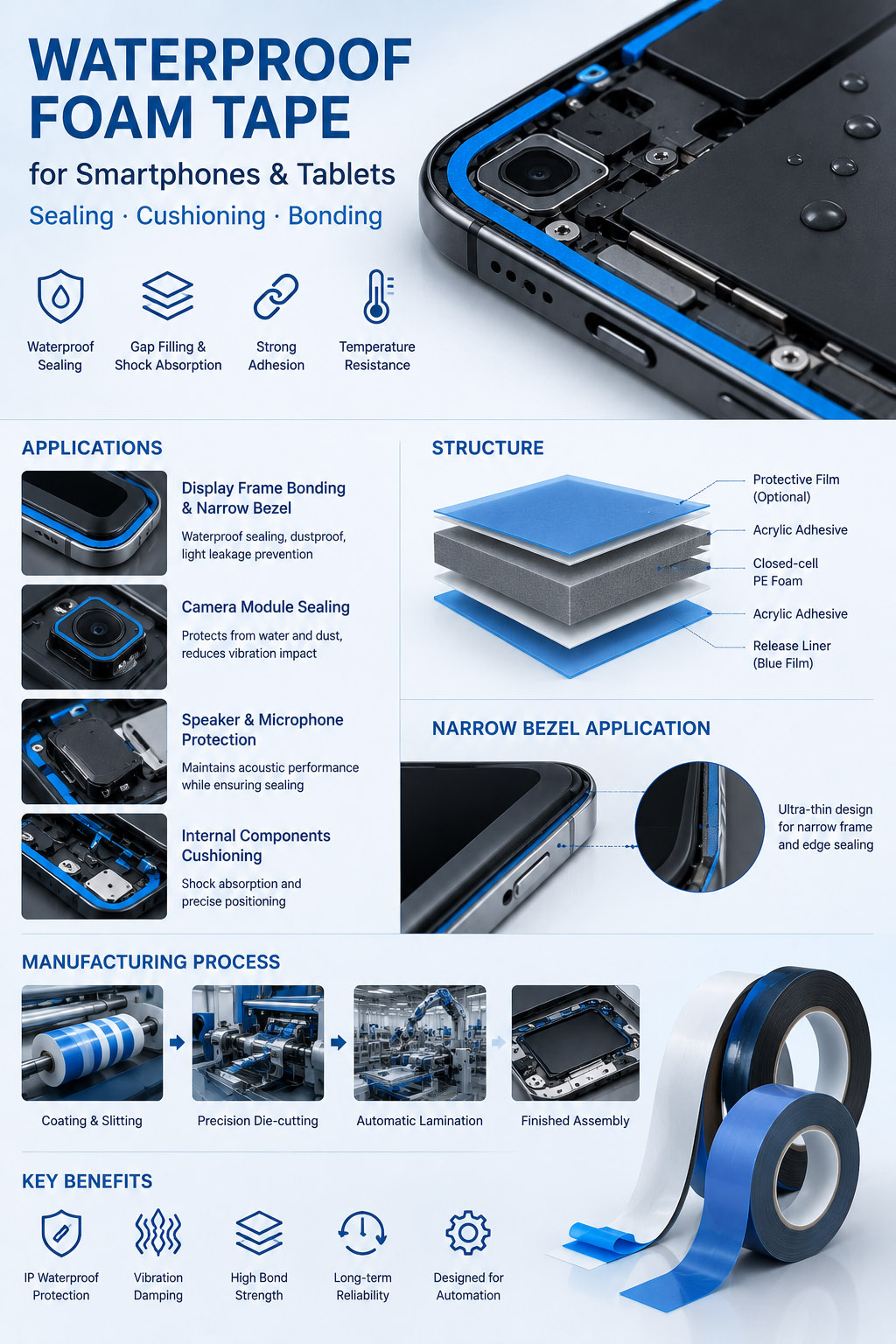
Waterproof foam tape is a double-sided pressure-sensitive adhesive tape with a closed-cell foam core. It combines strong adhesion, compressibility, waterproof sealing, vibration damping, and dimensional stability in a single solution.
Compared with liquid adhesives or mechanical fastening methods, foam tape offers:
Excellent waterproof sealing
Precise gap filling
Shock and vibration absorption
Easy automated assembly
Clean appearance without visible fasteners
Long-term durability under thermal cycling
These advantages make it ideal for today's compact electronic devices.
Main Applications in Smartphones and Tablets
1. Display Frame Bonding
One of the most common applications is bonding the display module to the middle frame.
The foam tape creates a reliable seal around the display while maintaining accurate spacing between components.
Benefits include:
Waterproof protection
Dust sealing
Gap control
Improved structural stability
2. Narrow Bezel Display Assembly
As display bezels become narrower, adhesive materials must provide high bonding strength within extremely small bonding areas.
High-precision die-cut foam tape allows manufacturers to:
Maximize screen-to-body ratio
Maintain uniform bonding thickness
Prevent light leakage
Improve assembly consistency
3. Camera Module Sealing
Foam tape is widely used around camera modules to prevent water and dust from entering the device while absorbing vibration that may affect image quality.
4. Speaker and Microphone Protection
Acoustic components require sealing without affecting sound transmission.
Special waterproof foam tapes help maintain device protection while preserving acoustic performance.
5. Battery and Internal Component Cushioning
Foam tape also protects internal electronic components by reducing vibration and compensating for manufacturing tolerances.
Typical applications include:
Battery fixation
Wireless charging modules
NFC antennas
Flexible PCB protection
Sensor positioning
How to Choose the Right Waterproof Foam Tape
Selecting the correct foam tape depends on both device design and manufacturing requirements.
1. Waterproof Performance
For smartphones and tablets, sealing performance is critical.
Choose tapes with:
Closed-cell foam structure
Excellent moisture resistance
Long-term environmental stability
These properties help support IP-rated waterproof designs.
2. Foam Thickness
Different applications require different tape thicknesses.
Typical recommendations:
0.15–0.25 mm for ultra-narrow bezel displays
0.3–0.5 mm for display frame bonding
0.5–1.0 mm for cushioning and sealing applications
The appropriate thickness should provide sufficient compression without affecting assembly tolerance.
3. Adhesion to Different Materials
Electronic devices contain multiple substrate materials, including:
Glass
Aluminum
Stainless steel
PC
ABS
PMMA
Painted metal
The adhesive system should provide excellent bonding to all required surfaces.
4. Compression Recovery
Foam tape must maintain sealing performance after repeated compression.
High-quality acrylic foam offers:
Low compression set
Excellent resilience
Long-term sealing reliability
5. Temperature and Aging Resistance
Consumer electronics experience repeated thermal cycling during daily use.
Recommended performance includes:
Excellent heat resistance
UV resistance
Humidity resistance
Long-term aging stability
6. Precision Die-Cutting Capability
Modern smartphones require highly accurate adhesive components.
Manufacturers should select foam tapes suitable for:
Precision die-cutting
Automatic lamination
High-speed production lines
Ultra-narrow frame assembly
Why Choose Nanobond Waterproof Foam Tape
Nanobond provides high-performance waterproof foam tape solutions specifically developed for consumer electronics manufacturing.
Our products offer:
Strong adhesion to glass, plastic, and metal
Excellent waterproof sealing
Superior shock absorption
High dimensional stability
Precision die-cut compatibility
Support for ultra-narrow bezel designs
OEM and custom adhesive solutions
With advanced coating technology and strict quality control, Nanobond helps manufacturers improve assembly efficiency while ensuring reliable long-term product performance.
Conclusion
Waterproof foam tape plays a critical role in modern smartphone and tablet manufacturing. Beyond simple bonding, it provides waterproof protection, structural support, cushioning, and manufacturing efficiency.
Selecting the right foam tape requires careful consideration of waterproof performance, substrate compatibility, thickness, compression characteristics, and precision processing requirements.
Choosing a reliable adhesive partner ensures higher product quality, improved production efficiency, and long-term reliability for today's demanding consumer electronics market.